
The Great River Road: Lake Itasca to St. Louis
- dougsmith51
- Oct 5, 2025
- 11 min read
NOTE: This is the 150th post on the Ciaowagen blog! Amazing that we've been able to keep it going these past seven years. Thank you to all our loyal readers!!
The primary focus of our 2025 RV adventure was a 32-day, 1,763-mile trip down the length of the Mississippi River, from its source in northern Minnesota all the way to the Louisiana delta. In a first (for us), we decided to join an RV caravan for this part of the journey, organized by Adventure Caravans, a company who provides guided trips all over North America and Europe.
Caravan Life
We'd run into Adventure Caravans groups at campgrounds in the past, which is why we decided to sign up with them. Our group included 14 traveler RVs plus 2 leader RVs.

We like to travel independently, so we weren't sure ahead of time how we would feel fitting into a very planned and detailed agenda:


In practice, we found the Caravan Adventures trip to be well organized and well led, with a good balance between organized tours, free time, and group social activities. Our fellow travelers were all in their 60s and 70s, retired, fairly healthy, and spry. Rigs hailed from New York, Pennsylvania, Ohio, Florida, Texas, South Dakota, Idaho, Oregon, Washington, and Virginia (us). Some rigs were motorhomes, others were trailers (typically 5th Wheels where the trailer connects into the bed of the pickup truck). Most of the rigs were longer than ours, although two were on the small side. Each rig and tow vehicle (like the Fittata) was tagged with a large yellow sticker and number (we were rig 12) so we could recognize each other on the highway.

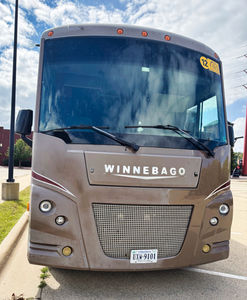


In a sign of customer satisfaction, we were the only newbies in the group - everyone else had traveled with Adventure Caravans before. Some had taken 2-3 trips, but one couple had gone on 11 trips and another on 30 trips, including previously taking the Great River Road.
We had a "no politics, no religion" rule, and that was very helpful in everyone getting along.
As we traveled from place to place, our route hewed close to the Mississippi River rather than just traveling on interstates. To allow this, we had detailed, turn-by-turn directions for each portion of the trip, provided in a multipage "trip log." We would have a group meeting the night before each travel day to review the route.

The group leaders included our "Wagonmasters," who had already led a number of different trips, and handled the coordination among rigs and with the vendors, campgrounds, and tour companies along the way. They would be the first to leave each campground so they could check us in at the next one.
Another couple served as "Tailgunners," who were the last to leave the campground, checking that no one had left things behind, and who could offer assistance to any RVs who might break down or get lost along the route. This particular couple were wagonmasters-in-training, hoping to lead their own trips in the future.
To encourage people to get to know each other, we would sometimes have assigned seating on tour buses that changed from trip to trip, so we'd always have new people to talk to. Also, we had social gatherings at least twice a week in the early evening, with snacks provided by either the odd-numbered or even-numbered rigs.
In addition to the travelers, we also had a mascot, Muddy, who would spend a day or two with each family and whose adventures would feature in our private Facebook group. When it was our turn, Jeannette felted him up with a lightning scar while we told a story of Lord Voldemort attacking our RV in the middle of the night ("The Hound Who Lived"). and also one about him getting into a drunken stupor when he misunderstood the sampling directions at a distillery we visited and downed a whole bottle rather than just a shotglass.


Bemidji, MN
We started our caravan in Bemidji, a town located near Lake Itasca. Bemidji is one of several towns in Minnesota and Wisconsin that claims they are the hometown of Paul Bunyan, the "tall tale" logger and his blue ox Babe.

Our main activity in Bemidji (besides getting organized and acquainted) was to visit Lake Itasca State Park. Lake Itasca is the recognized source of the Mississippi River, a point of some contention in the 1800s.

We'd been misinformed that you could stand astride the banks at the source. However, it is possible to wade calf-deep into the headwaters, which we all did.


It's very striking to see America's greatest river start as a small stream.

Before leaving Bemidji, we visited a local, family-run woolen mill.
St. Paul, MN
A long day's drive took us to our campground south of St. Paul, where we would spend four full days (two on tours, two where we were on our own).
This was our first time in the Twin Cities. We learned that Minneapolis had been established at the site of the only true falls on the Mississippi, and used those falls to power a variety of mill industries. St. Paul, on the other, was located at the most-northern navigable point of the river. Originally 13 miles apart, the cities grew into each other over time.
On the first tour day, we first visited the Minnesota Historical Society, which had several very interesting exhibits on the history of Minnesota.


After that, we had a lunch cruise on the Mississippi River itself. Although the boat was made up to look like a paddlewheel steamer, we were actually pushed along the river by an attached tug boat, like much of the barge traffic up and down the Mississippi.


We next visited the Wabasha Street Caves, underground passages carved into the limestone cliffs which had been used as a speakeasy during Prohibition, later for mushroom farming and storage, and currently as a wedding venue.


In the caves, we learned about St. Paul's long history as a gangster hangout in the 1920s and 1930s. We followed that up with a bus tour of the area, where our guide regaled us with stories of some of the gangsters who lived for a while in St. Paul, including John Dellinger and Ma Barker.
On one of our free days, we visited the Science Museum of Minnesota, which had lots of hands-on exhibits (fun for adults, not just kids).

There was a very interesting exhibit on "quakery" (fake health medicines and machines)...


...the obligatory dinosaurs, and the ecology of the Mississippi River.

Our next tour day took us on a narrated bus tour past a number of downtown sites. We stopped at 53-foot-high Minnehaha Falls...
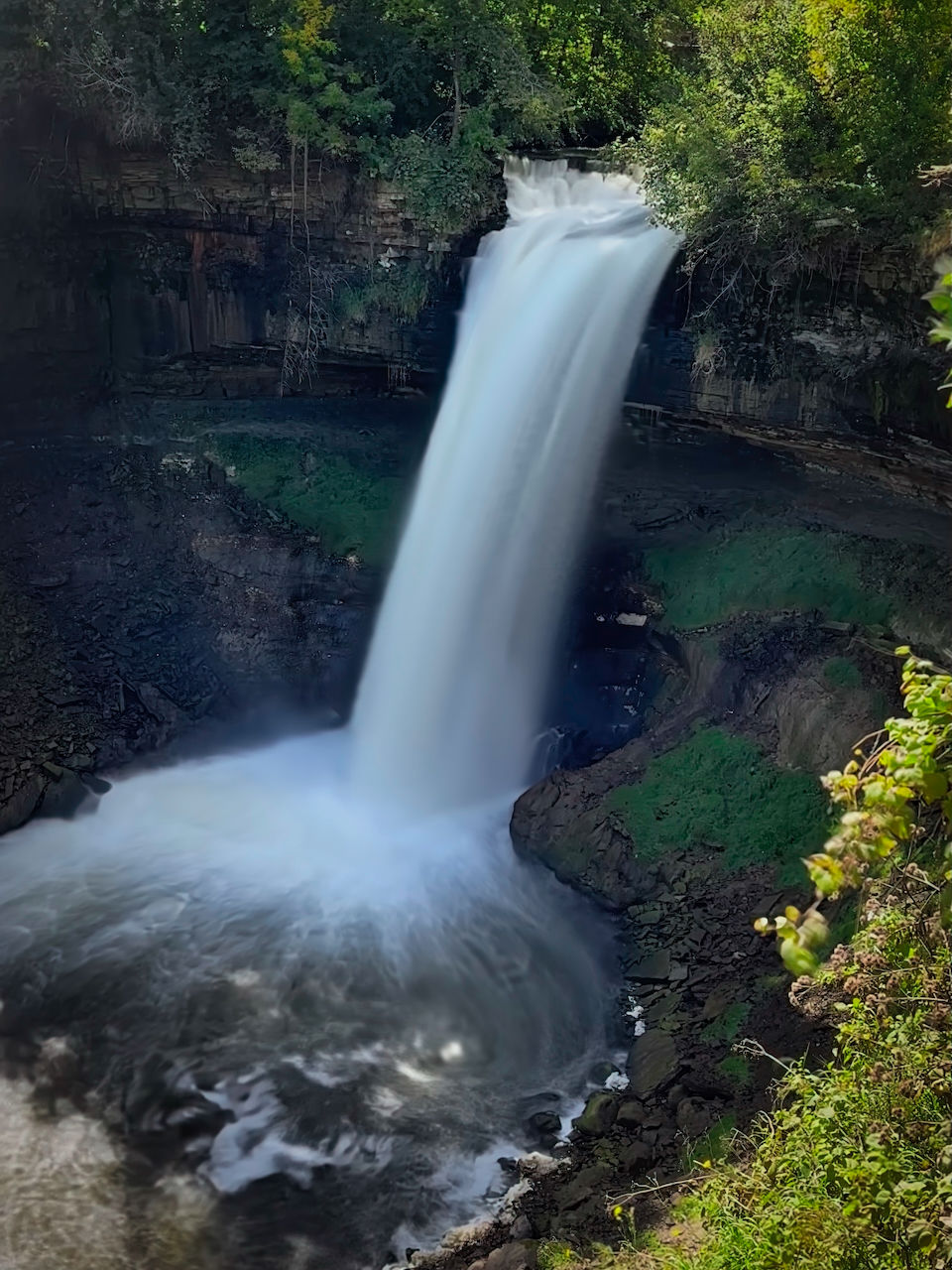
....and at Minneapolis' Guthrie Theatre to take in an expansive view of the riverfront.

We'd mentioned above that Minneapolis had started as a mill town, and historical remnants of General Mills stood on one side of the river and Pillsbury on the other.




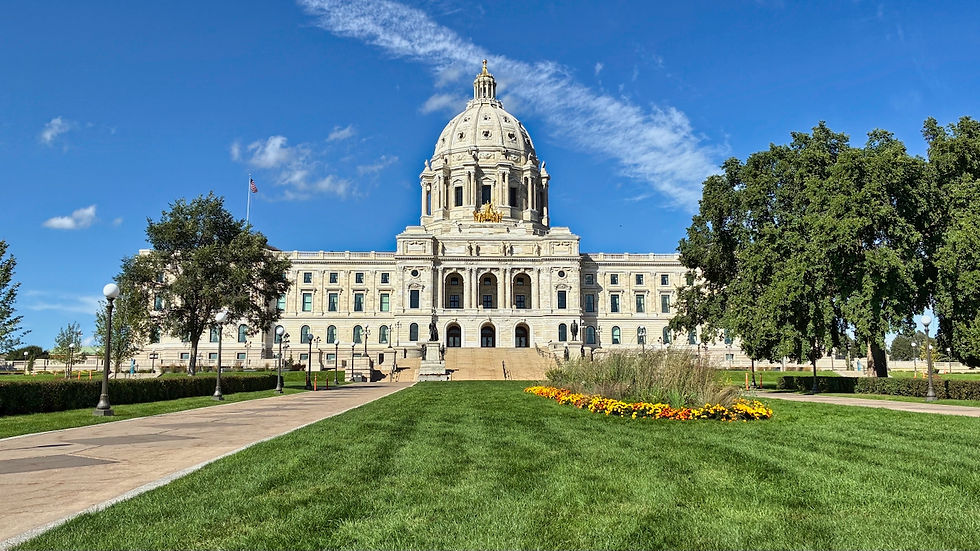
We also stopped to see the Minnesota State Capitol building in St. Paul.
We ended the day at the Chanhassen Dinner Theater and a production of Grease.

On our final full day in St. Paul, we traveled on our own to see the Mall of America (largest in the US), a place where one visit is sufficient but definitely a piece of Americana to see. The mall, which is up to four levels high, includes a huge number of stores and restaurants, an amusement park, and live entertainment.


Davenport, IA
The drive to Davenport took two days, with an overnight stop in Prairie du Chien, WI. We set up camp in Prairie du Chien and then drove, on our own, back upstream a few miles to visit Effigy Mounds National Monument. We hiked by some mounds built by the local tribes hundreds of years ago. We did not have time to visit other mounds located further uphill that were in the shape of various animals.


Partway through the next day's drive we stopped in Dubuque, Iowa to visit the National Mississippi River Museum and Aquarium.

We drove the rest of the way to Davenport, one of the "Quad Cities," for a four-night stay. The Quad Cities are Davenport and Bettendorf, Iowa, and Moline and Rock Island, Illinois.
We had two days of bus tours. The first day, we traveled to Moline and visited the John Deere Pavilion, sponsored by the company (the largest employer in the area) and featuring some of their latest farm equipment, including a $1M-plus combine with an air-conditioned cab and precise GPS steering.


Next, we visited a family-owned chocolate shop (Chocolate Manor) in Davenport, with a tour of the kitchen (hairnets mandatory) to see artisinal chocolates in the making.


Then it was on to a local company called Isabel Bloom that makes small concrete sculptures using a proprietary formulation. We were told they have quite a following in the Quad Cities area.


Finally, we traveled a bit north to the town of LeClaire, IA to visit the Mississippi River Distilling Company, a family-owned company with a number of award-winning bourbons and gins.

Walking around town after, we learned that LeClaire was the birthplace of Buffalo Bill Cody. All around town were small painted buffalos reflecting themes of the surrounding stores, including a kitchen store (bull in a china shop), a pizzeria, and an artists gallery (the buffalo was painted to look like Bob Ross, the TV artist).


The next day we traveled about 40 miles west to visit the Amana Colonies. Founded by a German religious sect in the early 1800s who moved first to upstate New York and then Iowa to escape persecution, they followed European farming traditions, forming several small villages where they lived in a communal style, surrounded by 27,000 acres of land that they farmed together. The commune structure was laid down in 1932 in an event called The Change, and the land holdings and businesses became a for-profit company with shares distributed to the residents.


Amana still farms the area (it's the second largest farm in Iowa). They also invested in industry (including refrigeration and air conditioning, as well as the first commerical microwave, the Amana Radar-Range). Those companies have been sold to others, but the factories still make products under the Amana label.
Finally, tourism plays a large part in the Colonies' current iteration.
Our last full day in Davenport was our own to plan, and we traveled 8 miles west to the Iowa 80 Truck Stop ("The World's Largest")...

...to visit the Iowa 80 Trucking Museum. Among the many trucks were an early snowmobile, a "show" truck, and the original REO Speedwagon.




Hannibal, MO
We next traveled to Hannibal, home of all things Mark Twain (Samuel Clemens), who grew up in this quintessential river town, and whose memories factor into many of his most famous books (Tom Sawyer, Huckleberry Finn, Life on the Mississippi).

The town is small but quaint. There is a good view of the town and the river from a hill called Lovers Leap.

On our arrival day, a Mark Twain impersonator imparted some homespun wisdom at the local winery. The next morning, after a trolley ride through town, Tom Sawyer and Becky Thatcher came by the campground for a conversation.

In the afternoon, we visited Samuel Clemens' boyhood home and museum. There is, of course, a white picket fence like the one in Tom Sawyer.


We also visited a Mark Twain museum in town that had, among other artifacts, Norman Rockwell paintings used to illustrate Tom Sawyer and Huckleberry Finn.

There is a famous scene in Tom Sawyer where Tom and Becky get lost in a cave. Missouri has a number of caves in the limestone hills near the Mississippi River, and young Sam Clemens explored them with his friends. We chose not to visit the very commercial Tom Sawyer Cave, but did explore nearby Cameron Cave, left in its natural condtion, by flashlight. We were the only ones signed up for that tour, so we had the guide (and the cave) all to ourselves.


In the afternoon, we took a riverboat cruise on the Mississippi. It was very peaceful cruising along the river and close by a tug assembling a barge train to travel on the river.


St. Louis, MO
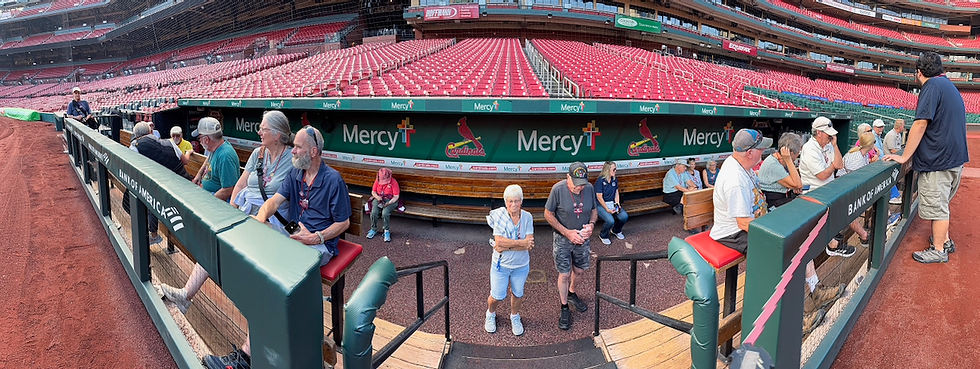
Then it was on to St. Louis for three full days. The first day we climbed onto our bus at 8 am (we were camped 30 miles west of downtown) and headed into the city. We took a tour of Busch Stadium, home of the St. Louis Cardinals, visiting some of the lounges and also the home team dugout. The stadium's architect also designed Camden Yards in Baltimore, and you can see some resemblances. We learned something of the skullduggery of baseball - for many years the visiting team's dugout only had one narrow wooden bench which was not protected from the sun or rain. The stadium is right downtown, and we could see the Gateway Arch peeking out from beyond the field.


In the afternoon, we took a tour of the Anheiser-Busch Brewery, walking among the brewing, finishing, and bottling buildings (it's a huge complex). We were also able to see one of the beer wagons that is pulled by Budweiser's Clydesdale horses.


The next day we drove to Meramec Caverns, a popular "show cave" west of St. Louis. They were discovered in the 1830s, but not commercialized until 100 years later. Jessie James used it as a hideout, and an episode of Lassie had been filmed inside the caverns.



Although they had not been left in their natural state, the Caverns were still quite impressive, with large rooms, some empty and others with many stalactites, stalagmites, columns, and cave popcorn. There was also a beautiful flowstone formation toward the end of the tour that was about 30-40 feet high. We would recommend a visit if you are in the area.





On our final full day in the St. Louis area, we again boarded a bus to travel into the city. We first visited Grants Farm, the home of August Busch. It was all decked out for Halloween, and there were many families enjoying the beautiful fall day and the decorations.

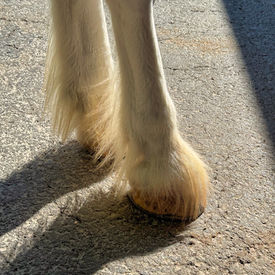
The main attraction (for us) was seeing some of the Clydesdales up-close-and-personal. They are beautiful horses, but HUGE. To qualify as one of the horses that pull the Budweiser wagon (there are three teams spread across the US, and they are on the road about 300 days per year), they have to stand at least 18 hands (about six feet at the shoulder), have to have a white stripe down their face, and all four of their legs need to be white at the bottom with "feathers" (long hair) around their hooves. We saw the huge difference in size between a regular horseshoe and a Clydesdale's shoe.







We then traveled to the Mississippi River and Gateway Arch National Park. The Arch was closed due to a Federal Government shutdown, but we were able to take a riverboat cruise on the river that provided an unobstructed view.


We watched a "tow" (a set of 9 barges pushed by a large tug) going up the river.

We passed under the oldest bridge on the Mississippi River: the Eads Bridge, built in 1874 and the world's first steel-truss bridge.

Just upriver from that, we passed under one of the newest bridges crossing the Mississippi.

In mid-afternoon, we picked up a guide for a bus tour around St. Louis. One of the places we visited was the site of the 1904 World's Fair, now called Forest Park. The World's Fair celebrated the centennial of the Louisiana Purchase.

Only one building remains from the World's Fair, the Art Museum. We also drove by the nearby site of the 1904 Olympics, the first held in America. The entire Olympic site is now a soccer field on the campus of Washington University.
To Be Continued
We've decided to end this blog entry at the halfway point of our trip down the Mississippi to keep it from getting TOO long. We'll follow up soon with the second half, covering Memphis down to New Orleans. Stay tuned!


Comments