
Montana, Wyoming, and the Black Hills

After two wonderful weeks in Canada, we crossed the border back into the U.S. on July 13, setting up at a KOA in Whitefish, MT on the west side of Glacier National Park. Our main purpose in settling there was as a jumping off point for visiting the Montana cabin of long-time friends of ours from home, Patti and Dave Hegland. They've owned land in Montana for about 50 years, close to the western edge of Glacier NP and just a few miles south of the Canadian border. They first built a somewhat basic cabin there, which we visited in 1988 during a Northwest trip we took shortly after our son Tory was born. Unfortunately, that cabin burned down in a bad fire in 2002. They rebuilt soon after, putting in a new, more fire resistant modern cabin, and that's the one we visited this year.
Patti and Dave were at the cabin for the week, and we stayed overnight with them.

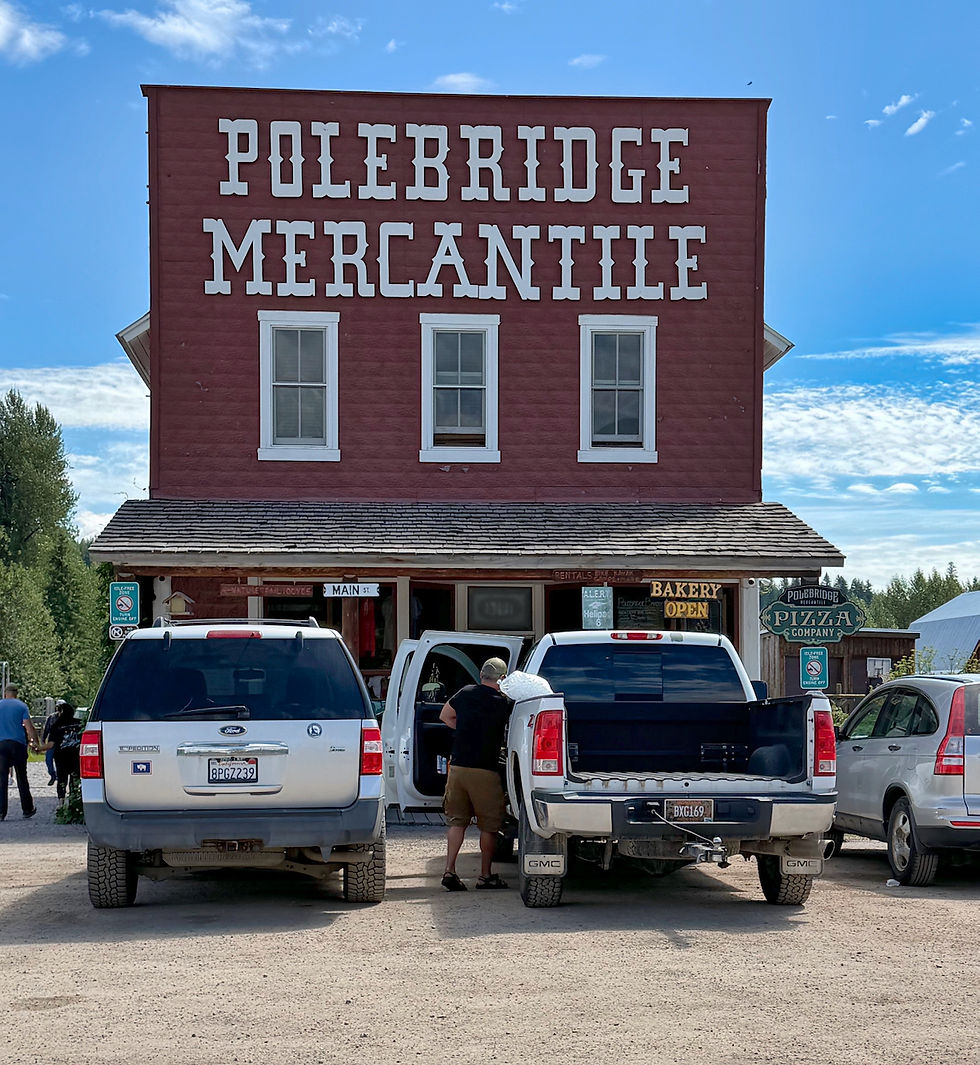
The Heglands left early the next morning for a two-day stay in Waterton Lakes National Park. The weather was beautiful, so we decided to drive into Glacier NP for a trip up the Going-to-the-Sun Road. We stopped at the small town of Polebridge - the only town on the entire North Fork Road - on our drive south to the park.
When we drove the Going-to-the-Sun road during June, before crossing up into Canada, rain and fog had completely blocked the views. Not this time!

We even managed to score a parking spot at Logan Pass, the high point of the road. This was a rare win, since the lot is often completely full.

We started hiking up the Hidden Lake Trail for a view of the lake. It was past the height of wildflower season but still quite lovely.

We were not the only ones on the trail, and the conditions ranged from relatively empty to crowded-but-manageable to super-crowded.
About halfway up the trail we ran into a snow field.

After watching people slip and slide up and down, we decided not to take the risk and returned to the parking lot. On the way back, we saw mountain goats, a marmot, and a herd of bighorn sheep.
We then drove back to the Ciaowagen in Whitefish. By the way, Whitefish is a cute town with a nice food scene. The town is older and supports a thriving ski tourism industry in the winter and various festivals in the summer.
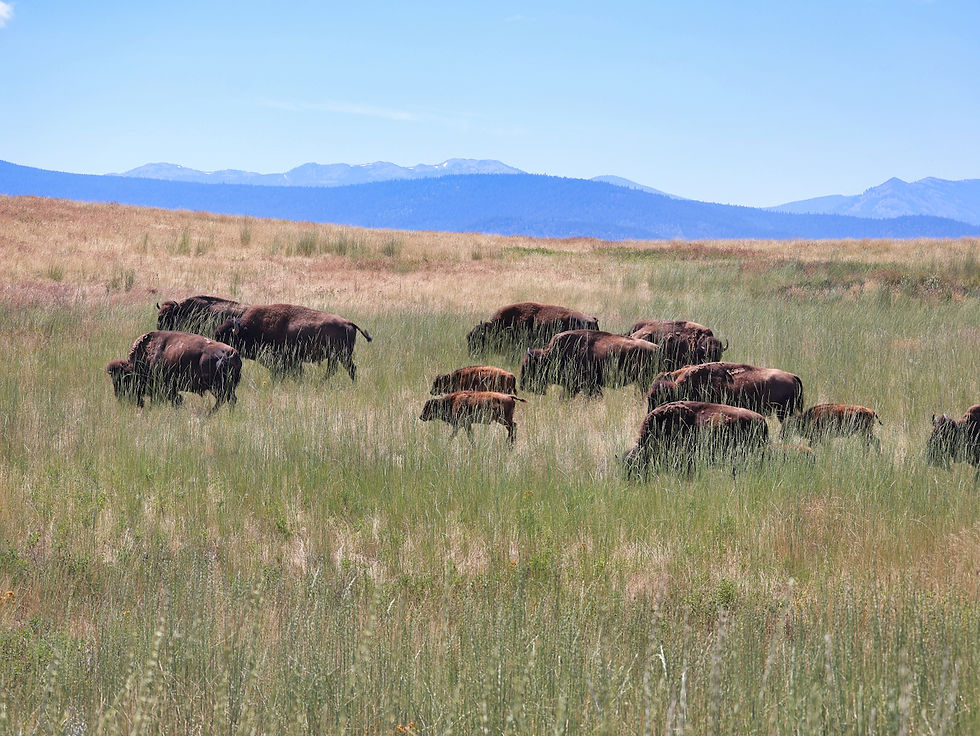
We spent the next day driving south to Bozeman, MT. On the way, we stopped at the CSKT Bison Range maintained by the Consolidated Salish and Kootenai Tribes (CSKT) on the Flathead Indian Reservation. A 19-mile-long one way drive takes you through the 11,500 acre range, home to some 400 bison and other wildlife.
We then completed our drive to Bozeman, staying for two nights. While there, we had a great dinner with Robert and Christine Smith, two of Doug's Harvard Business School classmates. It was great to catch up and we spent almost three hours talking at the table.

Then it was on to our next stop: Thermopolis, Wyoming. This small town in western Wyoming is the site of the world's largest hot spring, which puts out more than 3 million gallons per day. The springs sit in Hot Springs State Park and feed both a free bathhouse operated by the state and a couple of commercial facilities. We spent an afternoon at one of those commercial facilities, Hellie's TeePe Pool and Spa, soaking in the mineral springs.
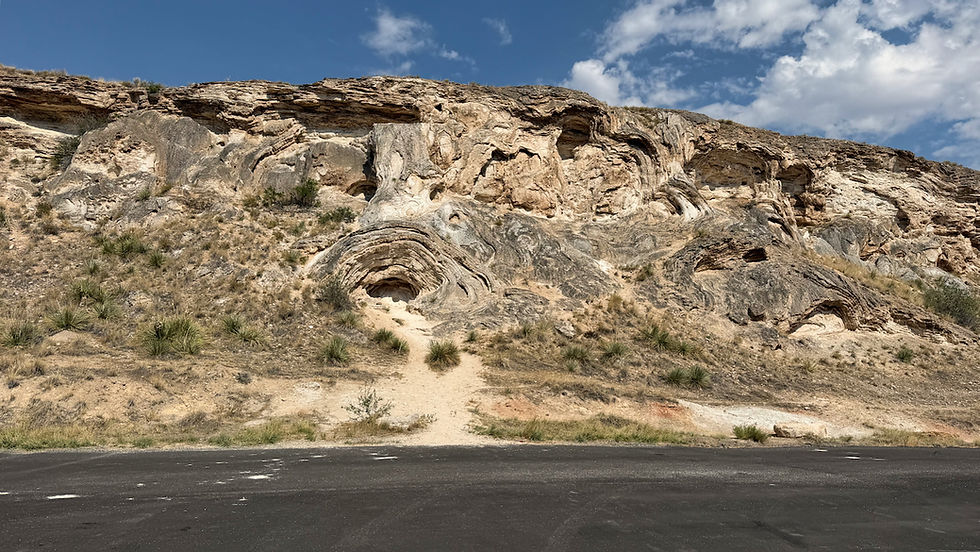
We'd visited Thermopolis in 2019 and also in 2002 during our family RV trip across America. Normally, the springs flow over beautiful travertine terraces. However, this year the state park is building boardwalks to allow tourists to see the terraces up close and had temporarily re-routed the flow away from the terraces.


The state park also maintains a herd of bison which we were able to visit by driving through park's backroads.
Just south of Thermopolis is the dramatic Wind River Canyon where the Wind River (also known as the Bighorn River) has carved a dramatic, 2,000-foot-high canyon for about 10 miles straight through the Wind River mountain range. One day we traveled through the canyon to the other side down to the town of Shoshoni and along the Boysen Reservoir.

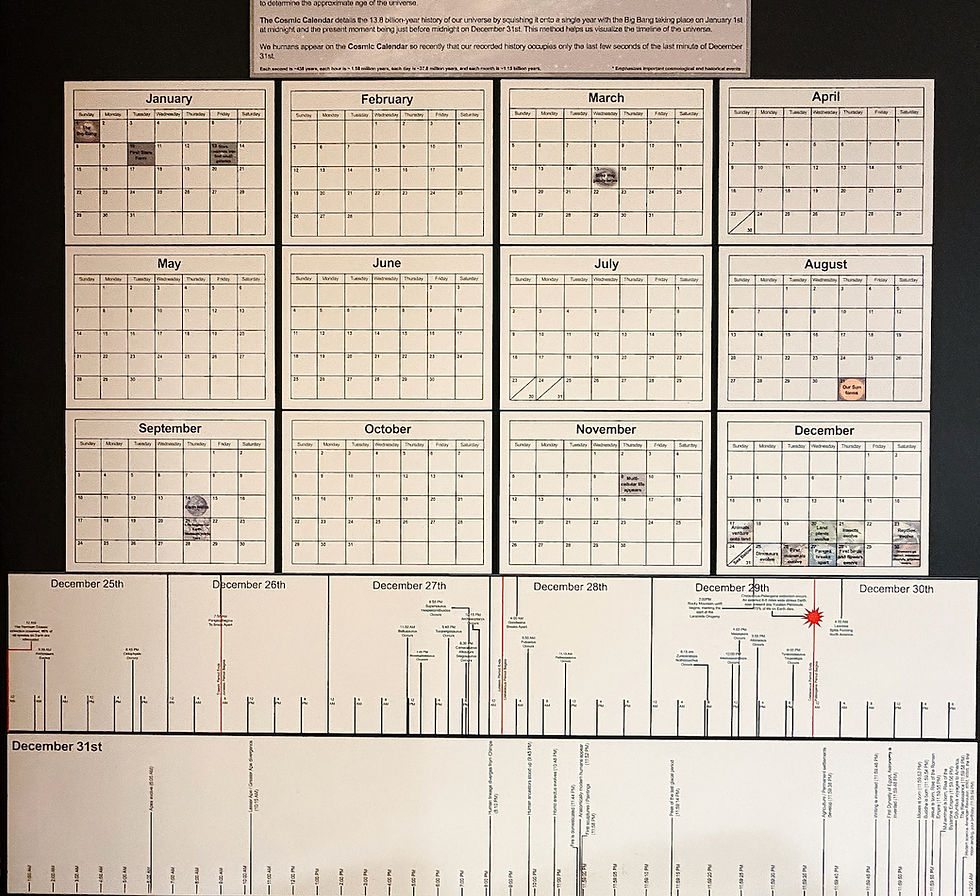
Before leaving town, we also visited the spectacular Wyoming Dinosaur Center. The museum looks quite unspectacular from the outside, but the collection inside is amazing. They have one of only four complete skeletons in the world of Archaeopteryx, the first dinosaur skeletons found with feathers. They have dinosaur eggs and hatchlings, and they also have a 106-foot-long Supersaurus skeleton on display.
We made friends at the campground with a couple from Charlotte, NC, Chris and Rachel Goddard, who have taken off for a year to travel America and vlog about their travels.
After six nights in Thermopolis, we moved on to Devil's Tower in the eastern part of Wyoming. Featured in Steven Spielberg's Close Encounters of the Third Kind, Devil's Tower is immediately recognizable. It was also the very first National Monument, designated by Teddy Roosevelt soon after Congress passed the Antiquities Act in 1906. We stayed at a KOA which sits close to the entrace to Devil's Tower.

Our first night there, we actually watched Close Encounters at the campground's outdoor theater (they've been showing it nightly for almost 50 years). We invited the Goddards, who were camping nearby, to enjoy the show with us.
While staying at Devil's Tower, we drove up to the park's visitor center and walked the 1.3-mile-long loop trail around the monolith which allows you to see it from all angles.
That evening, we went to a very interesting Park Service ranger talk on prairie dogs. There's a large prairie dog town on the flatlands surrounding Devil's Tower.


After three nights at Devil's Tower, we moved on to the Black Hills of South Dakota. Technically, these are not part of the Rocky Mountains (our focus for this eight-month RV trip) but they are not that far out of the way and only a two hour drive from Devil's Tower.
We'd visited the Black Hills as a side excursion during our 2023 tour around the Great Lakes and had wanted to go back and explore more. Since the Black Hills range is about 125 miles long from north to south, we situated ourselves near the middle in Custer, South Dakota.
The day of our arrival, we drove up to Mount Rushmore.
We hiked the 1.3-mile-long Presidential Trail loop which takes you up close to the bottom of the mountain.
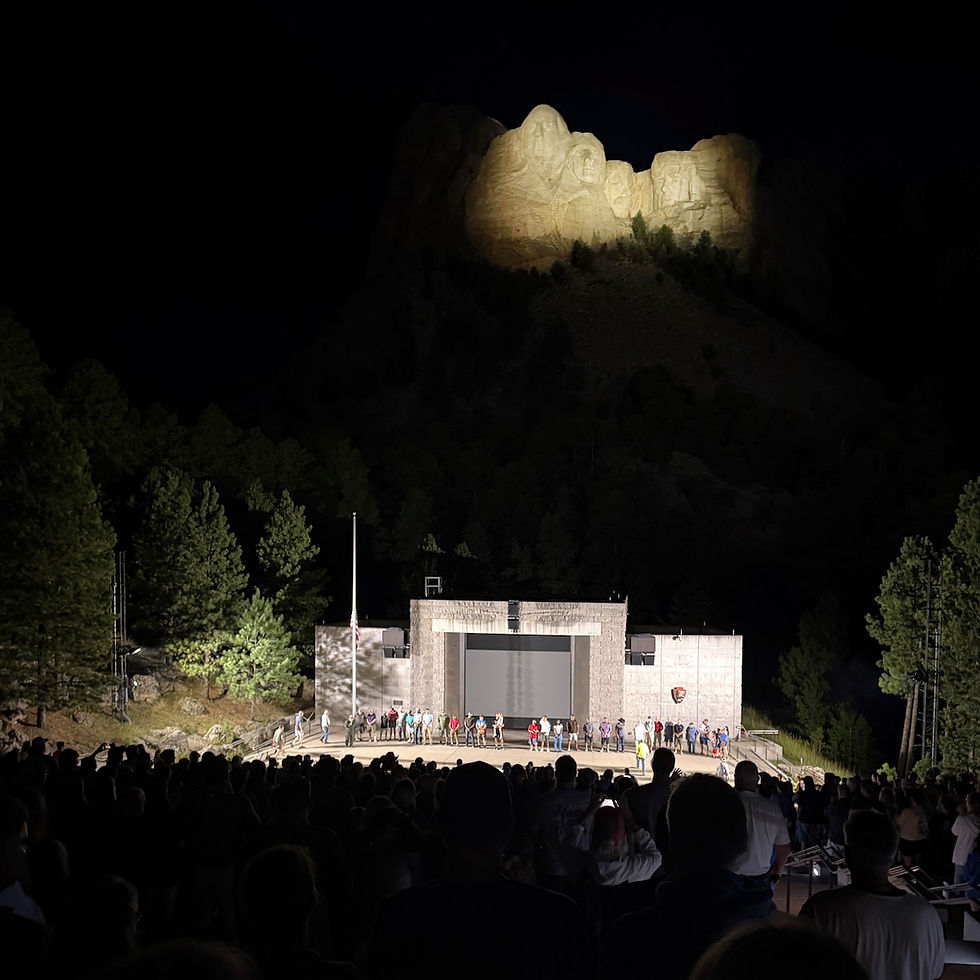
We stayed for the evening ranger program which takes place in the large amphitheater built in front of the mountain and which can hold up to 2,500 people.
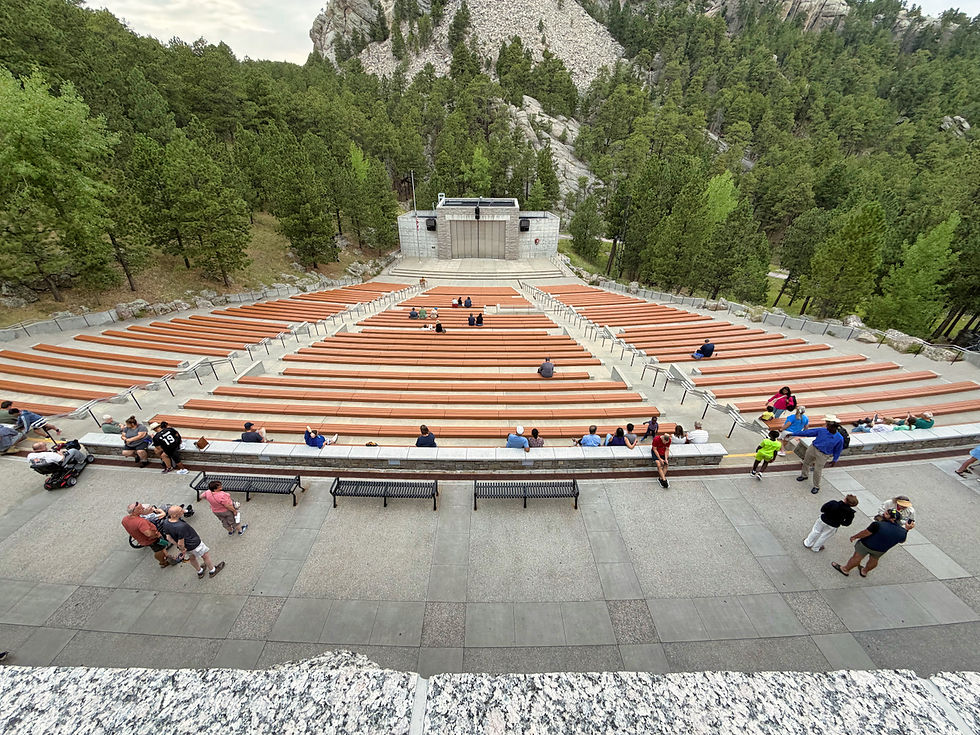
A ranger did a short live program about the history of patriotic music. This was followed by a movie spotlighting America but particularly the four presidents whose heads are on the mountain (Washington, Jefferson, Lincoln, Teddy Roosevelt). At the end of the program they illuminated the heads while veterans were invited to stand on the stage and be recognized. The Park Service has a difficult balancing act hosting a program that's patriotic without making it political, and they achieved that balance nicely.
We stayed in Custer for almost a week. Several of the days we explored nearby 114-square-mile Custer State Park. The park is beautiful and would surely have qualified as a national park if the state of South Dakota hadn't grabbed it up first.
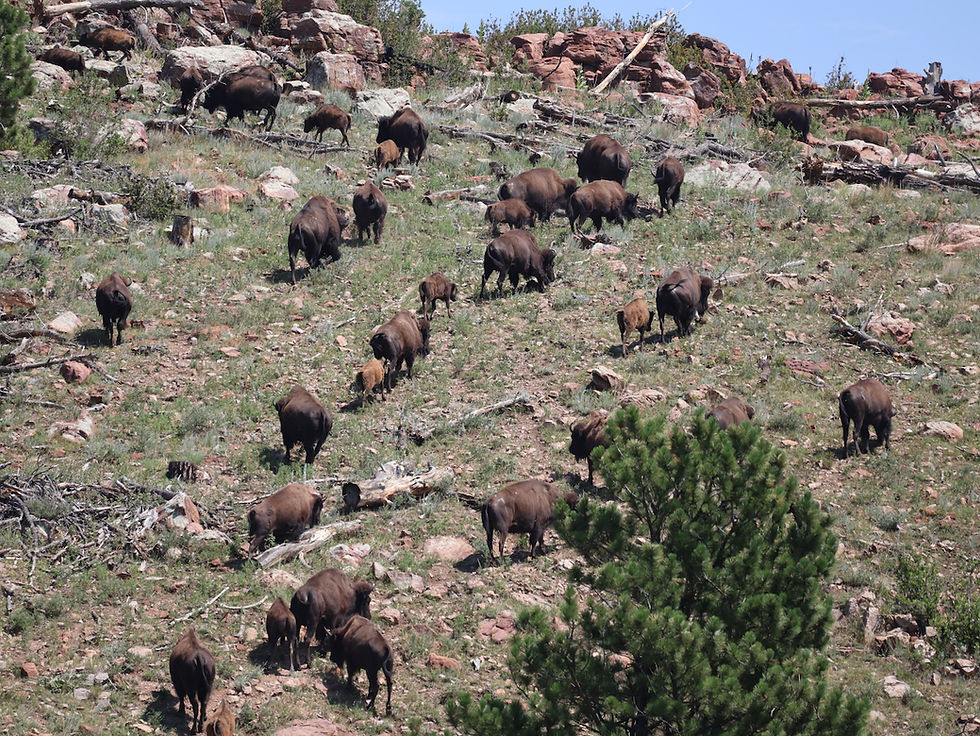
The park has several different sections and three scenic drives. On the Wildlife Loop Road, we came across some of the 1,500 bison that live in the park.
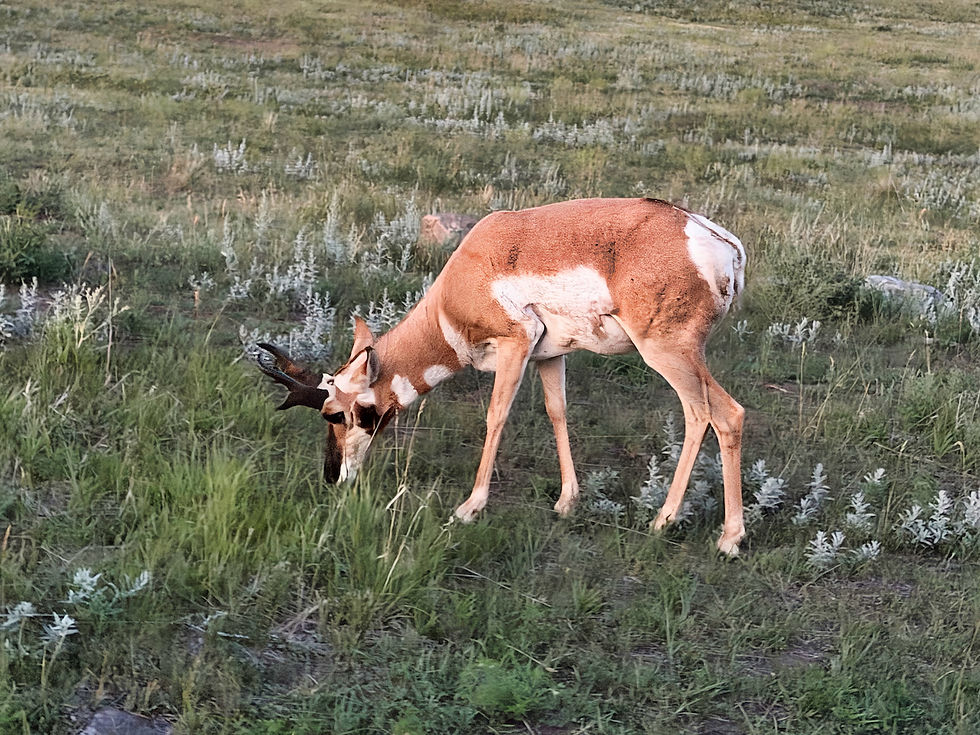
We also saw pronghorns...
...and some of the wild donkeys that were released into Custer State Park in the 1930s, descendants of donkeys that were used as pack animals for miners and tourists in the late 1800s. While there are clear signs saying to NOT feed wildlife, when we came upon a group of donkeys - also known as the "begging burros" - we saw that tourists and the donkeys were both ignoring the signs. Later the rangers told us that the junk food, chips, white bread, etc. that the donkeys were being fed had caused them to develop diabetes, very difficult to treat.
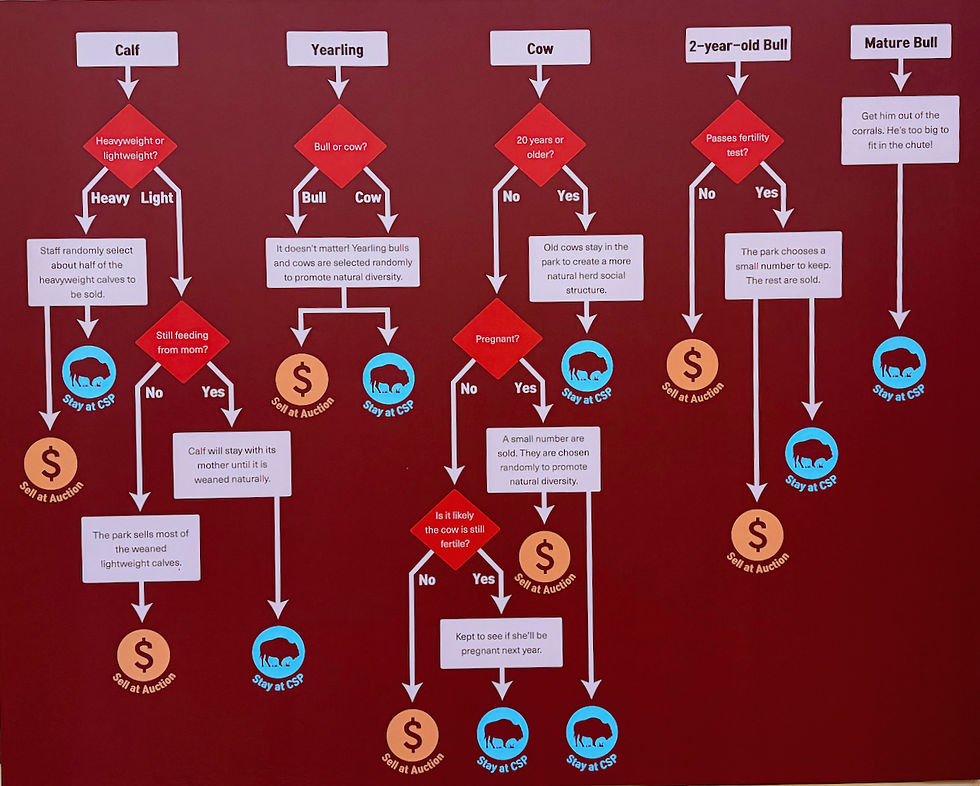
One day on the Wildlife Loop Road, we stopped at the park's Bison Center. To keep the herd a healthy size, the bison are rounded up each fall and some of them are auctioned off. It is a huge annual event with plenty of room for tourists to watch cowboys, cowgirls, and Native Americans from the local area participating on horseback to herd the bison to the sorting pens.

The Bison Center described the process of roundup, selection, and auctioning. It's a whole decision chart.
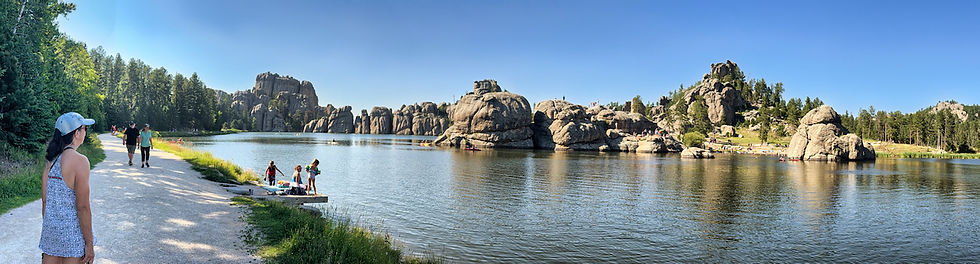
We drove the park's Needles Highway a couple of times. The highway rises through swtichbacks to a set of dramatic granite towers. The highway also has two small tunnels that only automobiles can fit through, one at a time.
Near the end of the Needles Highway is artificially-dammed Sylvan Lake, a popular recreation spot. We hiked around the lake.
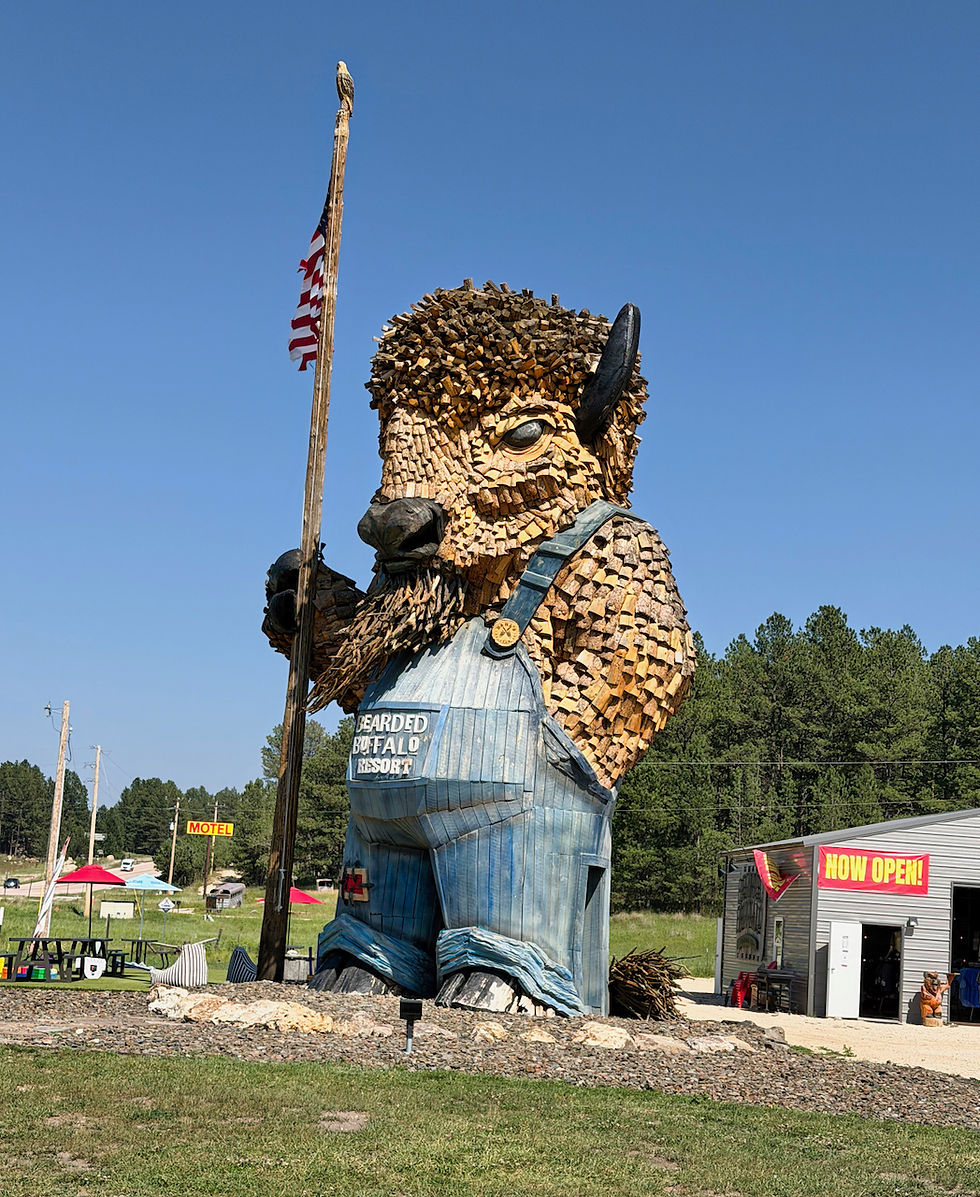
Rapid City, SD is near the top of the Black Hills, and we visited for shopping and one of the great restaurants in town. In the downtown area there are statues of various U.S. Presidents and Native American chiefs on most street corners. Outside of the local MdD's we saw a sculpture that might be suitable for President Trump's Garden of American Heroes.
One evening we drove to the park's State Game Lodge (a favorite of Calvin Coolidge who used it as a summer White House) for a nice dinner.

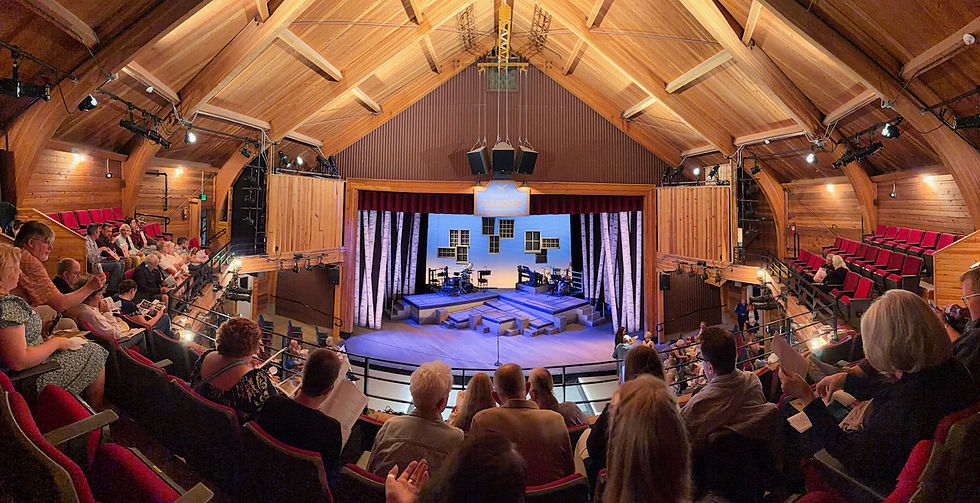
We then traveled to the Black Hills Playhouse (built on the site of an old Civilian Conservation Corps camp) to see a production of the musical Come From Away which chronicles the efforts of the small Newfoundland town of Gander to take care of the almost 7,000 airline passengers forced to land there on 9-11. It was a great show.

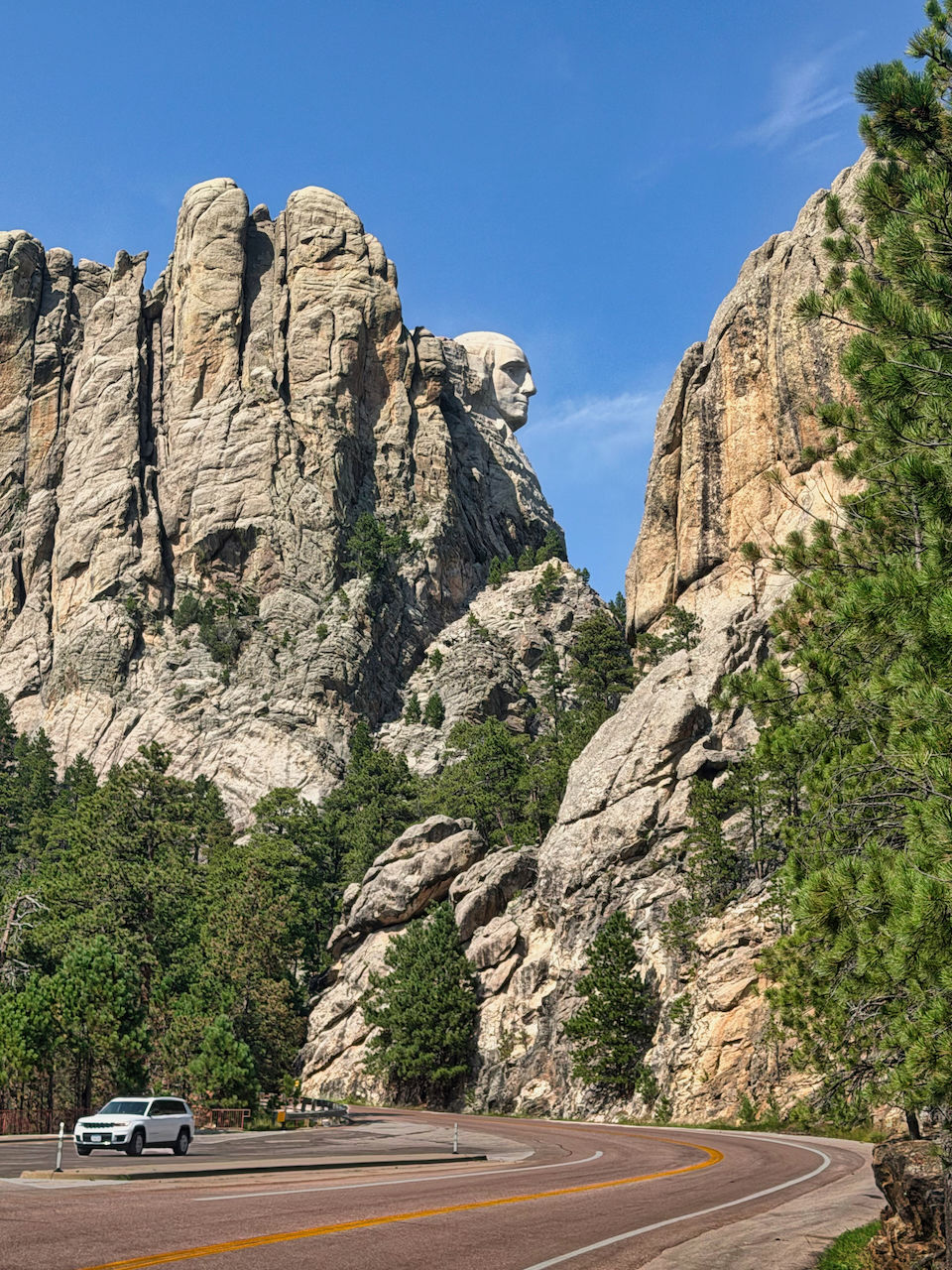
The third scenic road in Custer State Park is the Iron Mountain Road, which we took on our final full day in the area. Like the Needles Highway, it climbs up through mountains and narrow tunnels, some of which offer dramatic views of Mount Rushmore as you get close.

The road then drops down sharply and leads you close to the Mount Rushmore Memorial. We saw this very different view of the memorial from the road.
Badlands National Park is about a 90-minute drive from Custer, and we traveled there one day to drive through the park. We'd last visited Badlands in 2023, and the scenery there is always dramatic. A 60-mile long set of eroded hills divides the area into upper and lower prairies.
There are lots of animals in the park, including bison (which we saw way in the distance), pronghorns, and huge prairie dog towns.
On the way back from Badlands NP we stopped in at Wall Drug. Wall Drug is the "South of the Border" of the midwest, with billboards proclaiming your proximity starting 100 miles away. We arrived just as a thunderstorm was exiting town.

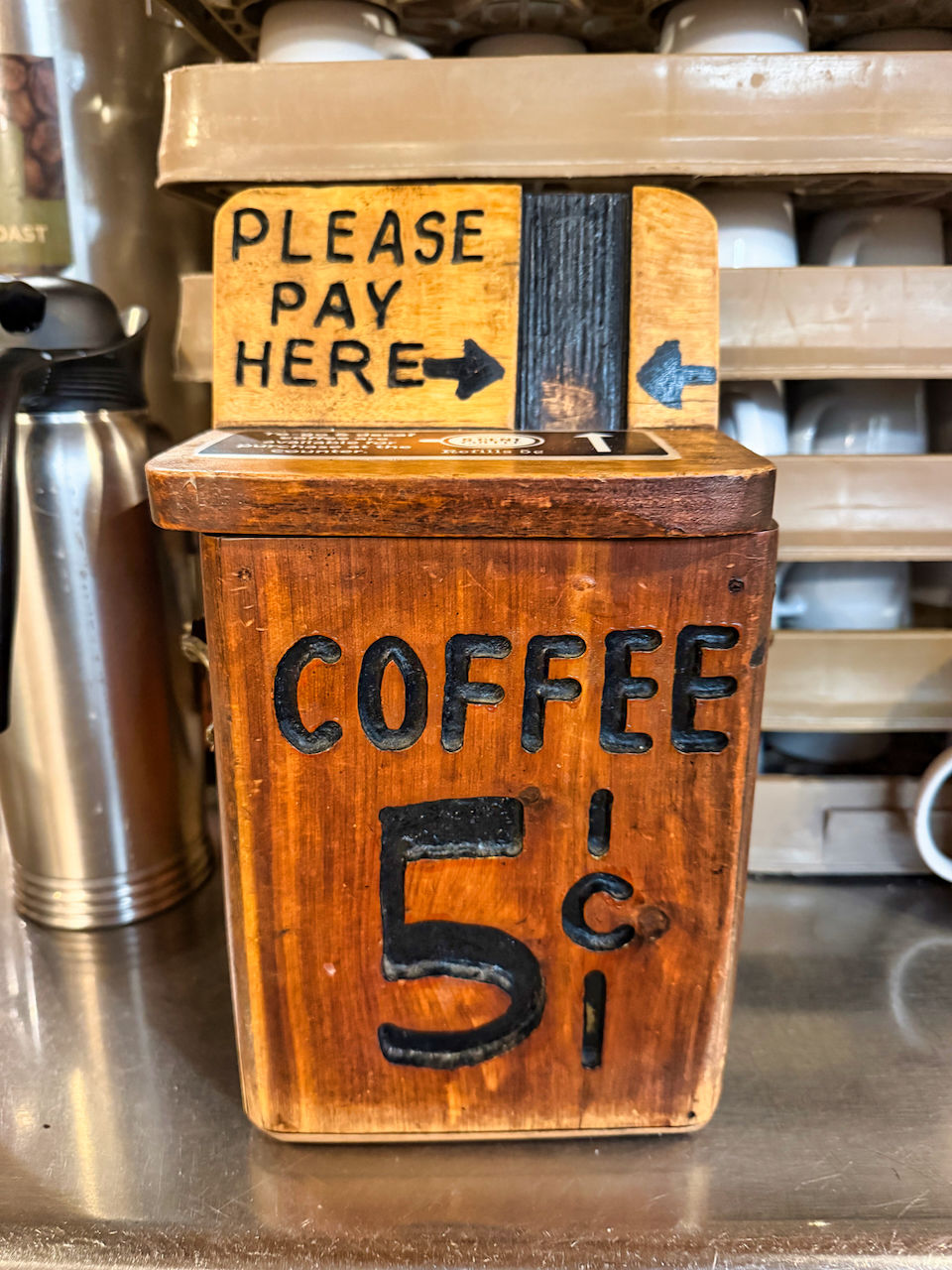
At Wall Drug, you can still get a 5 cent cup of coffee. If you're a veteran (like Doug), the coffee is free and they throw in a doughnut!
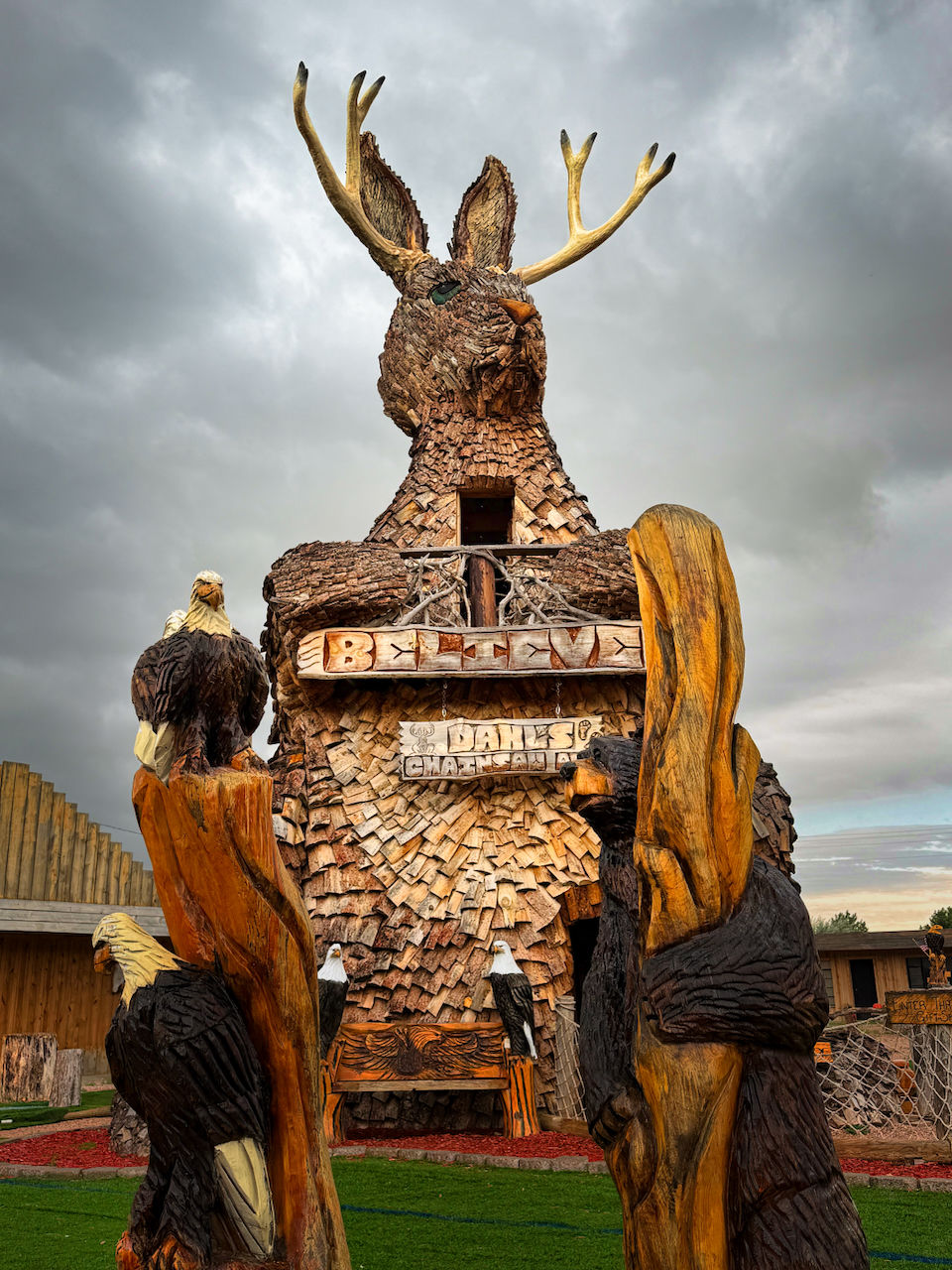
Also in Wall is the world's largest Jackalope!
The final Black Hills attraction we visited was the Crazy Horse Memorial, a work in progress since 1948 converting an entire mountain (not just a bit of the top) into a giant sculpture of the Indian chief Crazy Horse riding his horse, one of the leaders at the Battle of Little Bighorn. The sculpture memorializes a time when chief Crazy Horse was asked where his lands were and he looked out, pointed and said, "My lands are where my dead lie buried."
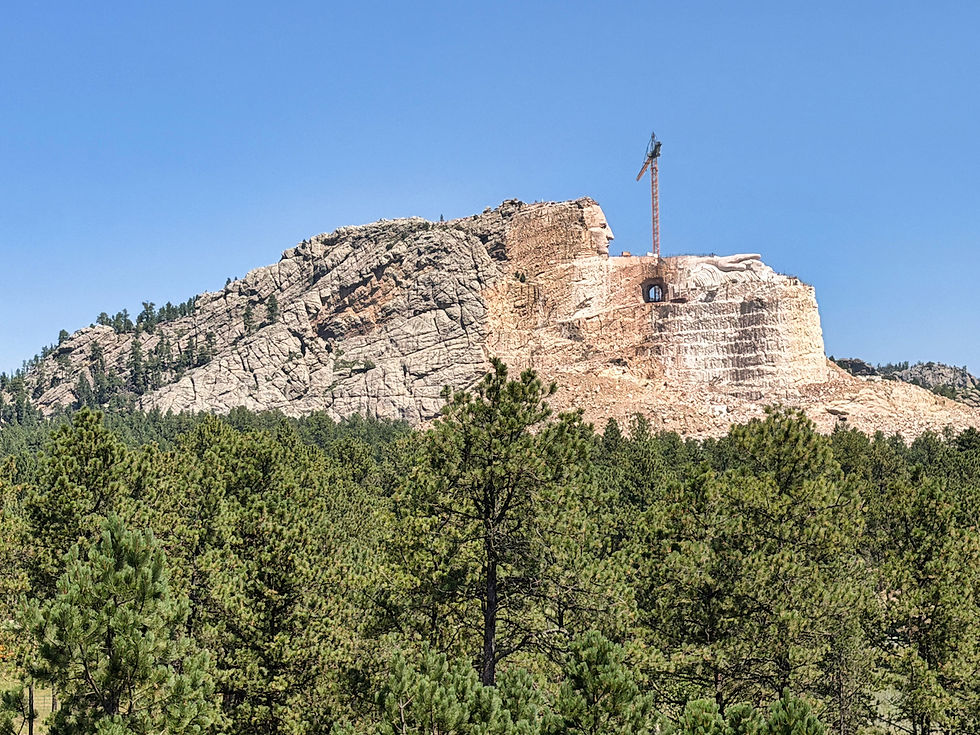
In the late 1930s, Oglala Lakota Sioux chief Standing Bear recruited well-known Polish-Amercian sculptor Korczak Ziolkowski to take on the task. The work is all done through private donations, including admission fees to the site. Ziolkowski refused Federal money, and his family (now in the fourth generation) has continued the work.
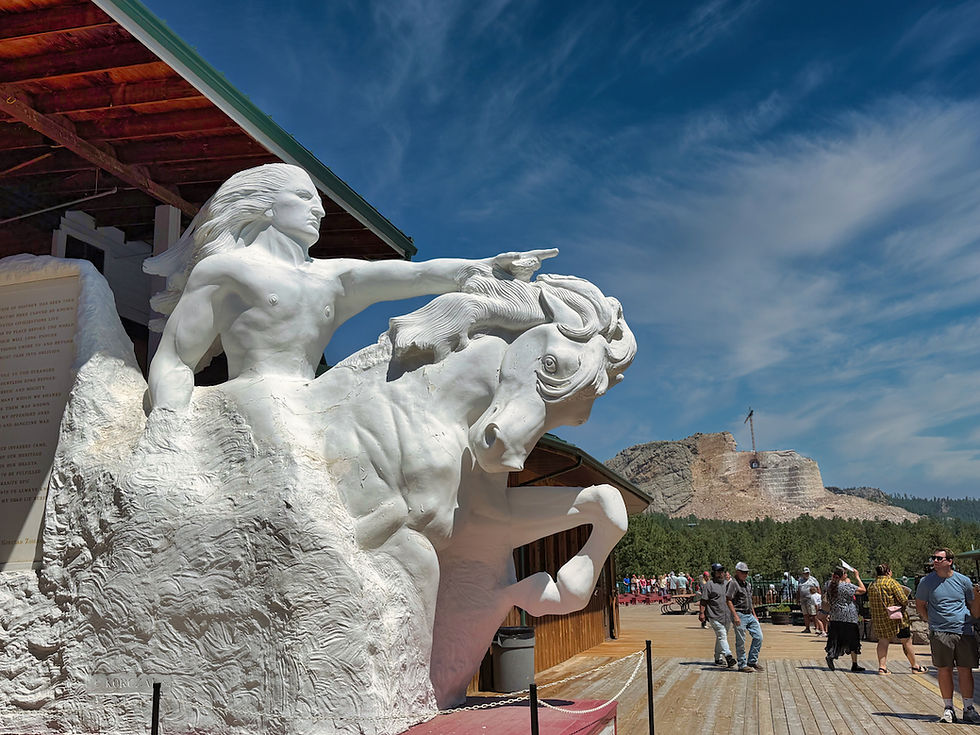
We first visited the Crazy Horse Memorial in 2002 and again in 2023. During this most recent visit, we saw that the pace of carving has picked up dramatically. Crazy Horse's arm is almost complete and they are starting work on the horse. It may take another 30 or more years before the whole work is completed, even at its accelerated pace.

We visited Crazy Horse twice. On the first visit, we spent time going through the growing collection for the Museum of the American Indian which will be built on the site. There is also a Native American college on the site that had just graduated its first students. Most students live on site with scholarships covering all costs.
During our second visit, Doug took a shuttle van up the mountain to see the sculpture up close. Everything is huge. During the earlier days, explosives were used to remove parts of the mountain not needed and for some of the rough-in work. For the past 10 years, though, the carvers have been using large diamond saws like those used in quarries. These, in combination with a crane now installed at the site, allow rock to be removed faster. They are considering adding a second crane, and have recently procured a large robotic cutting arm that will speed up the work on the sides of the mountain.
After a week in the Black Hills it was time to move on again, and on August 4 we drove southwest into Colorado where we'd be for about a month. More on our Colorado time in our next blog post!


Comments