
New Mexico

With just a month to go in our eight-month 2026 travels, we traveled from Mesa Verde National Park to Farmington, New Mexico, staying for a few days at the local Elks lodge. This would serve as our launching point for excursions in northwest New Mexico.
On our first full day in the area we visited Chaco Culture National Historic Park, a major Ancestral Puebloan cultural center used between 850 and 1250 AD. It's located at the end of a 20+-mile-long dirt road. Also referred to Chaco Canyon, the area is the site of several large pueblo structures which drew visitors from other pueblos in the Rio Grande region for ceremonies. There are still remnants of straight, 30-foot-wide roads leading to the area from these pueblos. When a road ran into a hill or mesa, it went straight over the top rather than being diverted.

Most of the structures in the canyon are still inm an "unexcavated ruins" state.

However, the largest and most impressive, Pueblo Bonito, has been excavated and can be visited. After arriving at Chaco Canyon, we joined a ranger-led tour of the site.


A massive, 100-foot-high section of the canyon wall known as Threatening Rock collapsed onto Pueblo Bonito on the afternoon of January 22, 1941, destroying about 30-60 rooms at the rear of the structure. Most of the pueblo was not damaged, fortunately.

Our guide led us around the site, explaining the history and some of the features. Some parts of the pueblo structure were four-stories tall, with upper levels accessed by ladders. Circular kivas dotted the site. The stonework was in excellent condition and many of the original wood ceiling, door and window frames were intact.
After the tour ended, we were able to walk through some rooms on our own.
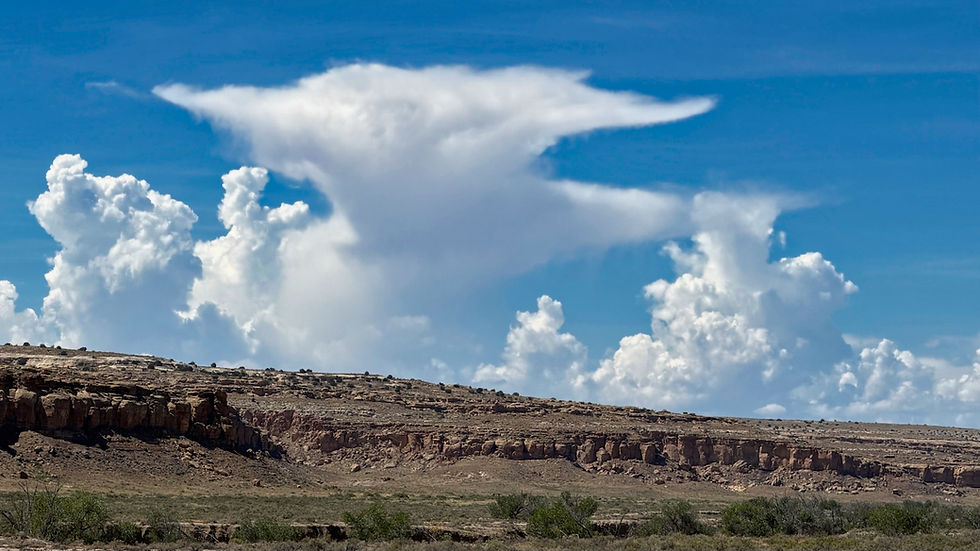
The next day we drove north to Durango, Colorado for a ride on the Durango & Silverton Narrow-Gauge Railroad, traveling up to Silverton, Colorado - a place we'd visited a couple of weeks before by driving the Million-Dollar Highway from Ouray. To maximize the scenery we'd see, we rode from Durango to Silverton on a bus.


The town of Silverton is old-school western in architecture, with many tourist shops. The main street is paved, but most of the rest are dirt roads.
After a couple of hours in town, we returned to Durango on the train, pulled by a steam locomotive. We'd opted for seats in an open car, which provided great views of the mountains and forests as we rode through the canyon of the Animas River. The track wound through spectactular scenery and rock walls hand-craved from granite. There were places where the rock walls were just beyond the reach of one's hands. The train had to be routed around the mountains since the rock would have been difficult to tunnel through.
You never know ahead of time whether these tourist excursions are worth the money you pay, but we were genuinely impressed by the train ride and would recommend it if you're ever in the area.
The following day we drove to the Four Corners Monument, where Arizona, New Mexico, Colorado, and Utah come together at a single point. We'd been there in 1991 when the monument was surrounded by sand and dust and Navajos selling trinkets laid out on blankets. In the intervening years the Navajo Nation has added a lot more infrastructure to the spot.


We departed Farmington and headed east to Taos for a couple day's stay.
We visited the Taos Pueblo on the edge of town. It has been occupied continuously for over 1,000 years. Many contemporary puebloans live in individual homes in the surrounding area, but we were told that about 5-6 families (constituting about 50 people) live full- or part-time in the two main sections of the pueblo structure.


Some areas were off-limits to us, but we could wander through other areas and visit shops that had been set up inside. NOTE: It was clear to us that many of the existing pueblos in New Mexico depend on gambling, tourist entry fees, and sales of Native-made goods for their livelihood.
There is no plumbing or electric service in the Taos Pueblo. We saw a kitchen where both the stove and refrigerator were running off a propane bottle. Several residents told us they do most of their baking in outside ovens.
The adobe that covers the buildings in the pueblo is made from a mix of water, clay, sand, and straw. It may need repairs several times a year, especially after heavy rains.
There is a cemetery by the ruins of an old church that was burned by the Spaniards.

A newer church was built in the 1800s.

There is also a Veterans memorial near the entrance to the pueblo.

While in Taos we also visited the Earthship community, more than 100 homes built using "biotecture" and sustainable materials to handle all their heating, cooling, water, and electrical needs. We toured the visitor center which showcased many of the technologies, including how water is recycled multiple times for washing, sewage, and growing plants.

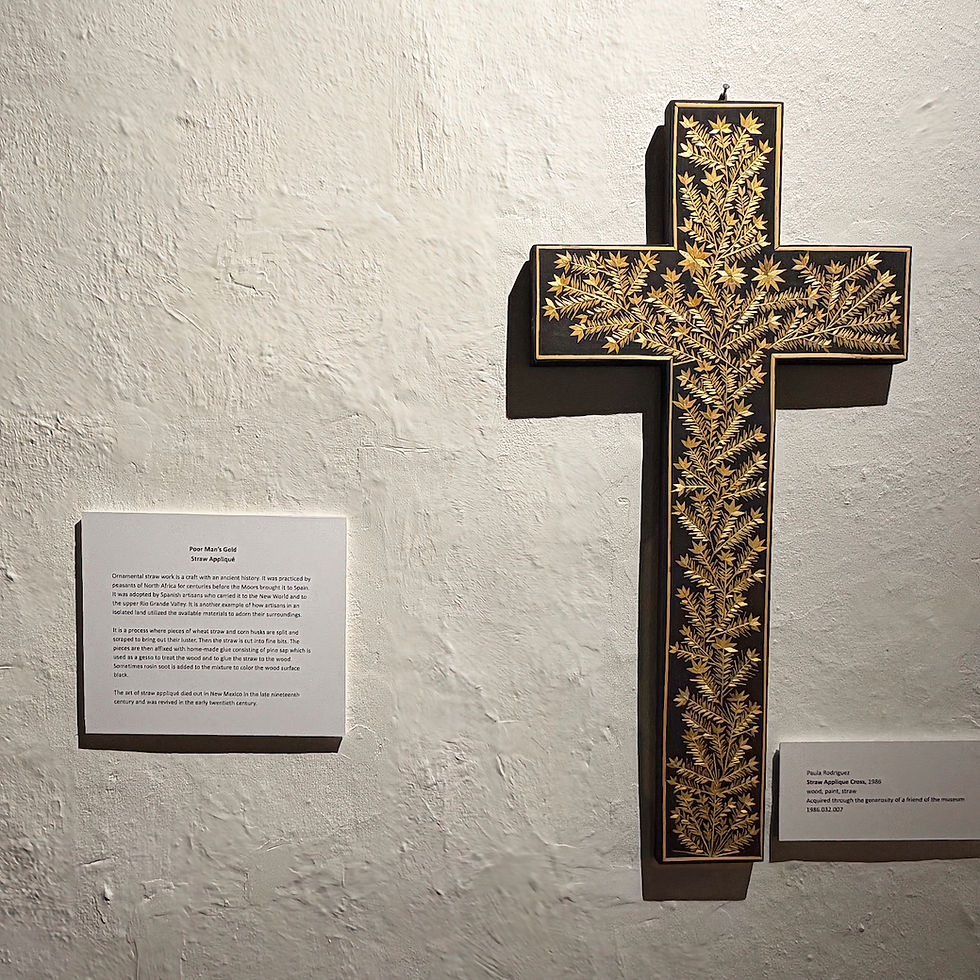
We also visited the Millicent Rogers Museum, founded by and honoring Millicent Rogers, an East Coast socialite and jewelry designer who settled in the Taos area toward the end of her life.
The Museum focuses on Native American and Spanish colonial art.
We moved south to Santa Fe for two weeks, settling in at Santa Fe Skies RV Park where we'd stayed a couple of times before, including during the early days of COVID in 2020. The owner of the park has a friend who sculpts art from found objects and metal and sculptures are scattered throughout the campground. The outside of the park is ringed with old vehicles and farm equipment.
During our first week in Santa Fe we visited the Georgia O'Keefe Museum downtown.

The museum showcases O'Keefe's artistic journey from girlhood in Wisconsin to art school in South Carolina to New York City (where she met and eventually married her mentor, the photographer and gallerist Alfred Stieglitz) and finally to New Mexico.


The photo below on the left shows O'Keefe at work in her studio in New York City. You can see that she has natural objects laid out in front of her. The painting on the windowsill is in the Santa Fe museum.
While finishing up at the museum, we heard a loud hammering overhead. When we approached the door to leave, we saw that hail covered the sidwalks and a river of water was flowing down the street.

Another day we drove up to Los Alamos and hiked the Kwage Mesa Trail Loop (used by both humans and horses) out to the end of a finger-like mesa.
The Manhattan Project conducted explosives tests in the side canyons during World War II.

Our oldest son Tory flew to New Mexico to join us for a few days, and we picked him up at the Albquerque "Sunport" (their international airport). On the first full day of his visit, we went to Meow Wolf, a giant, walk-through art exhibit where you can touch everything, explore secret rooms, and step into different fantasy worlds.

The overall theme of the exhibit is "The House of Eternal Return" and you enter through the door of an ordinary-looking two-story home. Once inside, you discover other rooms and other areas by ducking through closets, refrigerator doors, and fireplaces. Each "room" is designed by a different artist, and over the years the rooms evolve a few at a time. It's all quite psychedelic.
The next day we drove Tory up to Taos on the High Road, a scenic route that goes through badlands and up over mountains. The weather was on-and-off rain, but we still had beautiful views. After lunch of authentic New Mexican cuisine, we visited the gorge of the Rio Grande River, crossed by a bridge some 650 feet high.

Tory, who is a big hiker (he hiked the entire Appalachian Trail when he was 17-years-old), was interested in exploring a trail in the area. Driving down into the river gorge and up the other side, we reached the parking area for the Traders Trail, which leads to the rim of the gorge. As there were continued rain threats, we let him hike on his own for a couple of hours while we went and grabbed coffee in Taos.
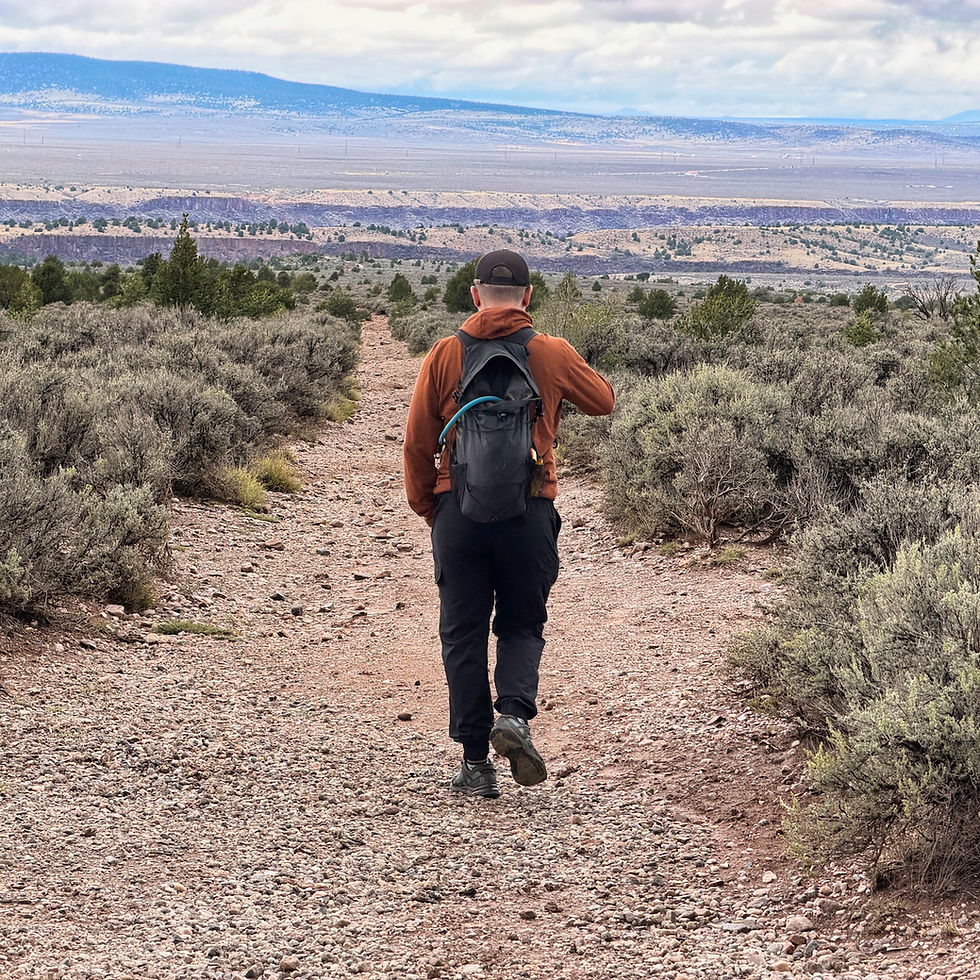
When we picked him up, a beautiful rainbow had come up over the desert.

We finished our day with a couple of hours at Ojo Caliente, a resort featuring hot spring pools near Taos.
On Tory's last day, we drove down toward Albuquerque and took the tram up to the top of Sandia Peak, which overlooks the city laid out on the plain to the west. We had beautiful views on the way up, but only peeks of the valley as cloud layers streamed over the ridge line. We did a small loop hike at the top.

We dropped Tory off at the airport and returned to Santa Fe.
We traveled the next day to the Dale Balls trails area just northeast of the city, a nature preserve that weaves through neighborhoods.

A couple of days later we drove west to visit Bandalier National Monument, where another set of Ancient Puebloans lived 800 years ago. 1.2 million-years-ago the Jemez Supervolcano erupted, depositing a layer of ash (called "tuff") almost 1,000 feet deep on the surrounding plain. Over time, Frijoles Creek carved out a canyon.
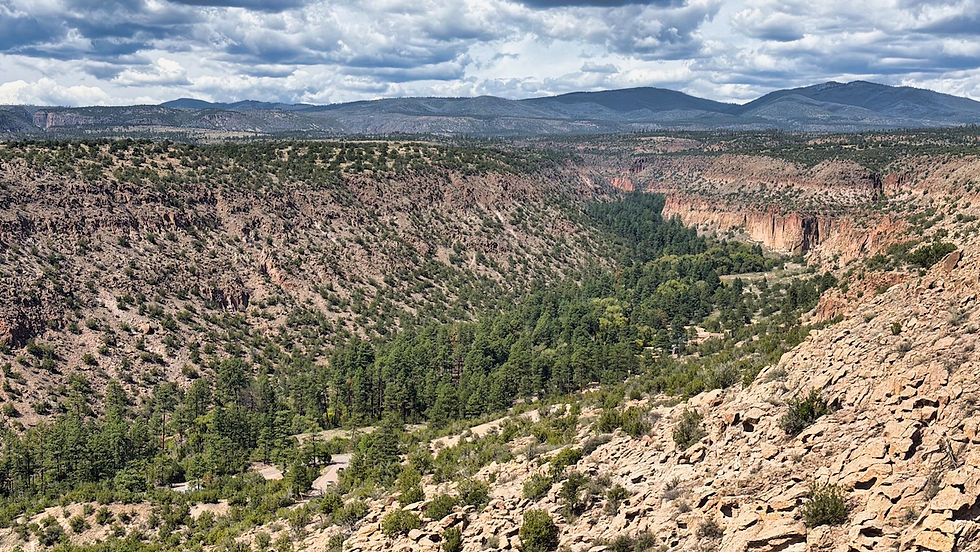
The puebloans built a large two-story pueblo structure and also set up dwellings in cave hollows on the cliffsides. A loop trail leads you past both.

After completing our visit at Bandalier, we drove a few miles west to visit Valles Caldera National Preserve, which formed after the supervolcano eruption had collapsed in on itself, forming a bowl almost 10 miles wide. Part of this bowl is a wide, open meadow, which we crossed to visit the Volcano Discovery Center.


The Preserve was celebrating their Fall Fiesta, featuring performances by a number of local tribes.

On Monday, Doug drove to see Kasha-Katuwe Tent Rocks National Monument, which sits in the Cochiti Pueblo about 30 minutes from Santa Fe.

After COVID, the National Monument was closed for about four years, but reopened in 2024 under joint control of the Pueblo and the U.S. Bureau of Land Management. You need to get permits from both to visit, and the number of visitors is limited. Only one reservation was available when we looked, which is why Doug went by himself.
Kasha-Katuwe's cliffs have eroded over time leaving unique cone-shaped structures along the edges. A loop trail through the canyon leads you to stunning views.

Doug also hiked partway up a slot canyon that branches off from the loop trail.


During our second week in Santa Fe, it rained quite a bit as rain bands from Hurricane Polo swept across the Southwest. The skies in New Mexico are always amazing because you can see weather coming from 30 or 40 miles away. We were treated to some amazing rainbows!
On Friday, October 2, we departed Santa Fe and drove an hour south to Albuquerque for our second visit to the Albuquerque International Balloon Fiesta (the time was in 2021). We thought about including the Fiesta in this blog post, but after taking almost 400 pictures and having many great experiences, we knew that our loyal readers might have to spend an hour slogging through a post that included the Fiesta on top of our other New Mexico experiences! We'll leave you with the teaser below and drop a post devoted to the Fiesta sometime in November.
After leaving the Fiesta grounds on Monday morning, we drove to the nearby Albuquerque Elks Lodge for final preparations before heading home to Virginia. We'd decided to leave the Ciaowagen stored in Albuquerque for the next three months, rather than drive it all the way home to Virginia. Why? Because we've planned another 7-month-long trip (perhaps the very last one...) starting in 2027. Here's an early preview:

We moved our e-bikes into the RV, placed all our paper products, food, and summer clothing in large plastic tubs (less temptation for mice), and loaded up the Fittata with items we wanted to have at home.

On Wednesday, October 7, we moved the Ciaowagen to the Albuquerque storage place we'd selected, met a mobile RV technician there who winterized the RV, and were on I-40 East headed to Virginia by 3:30 pm. Over the next four days, we drove 1,906 miles, arriving Saturday, October 10 at 2:30 in the afternoon. We switched drivers every two hours and walked around for 5 minutes before starting up again. A long drive, but not as onerous as we'd feared, partly because it was Interstate all the way (I-40 to I-81 to I-66 to I-495).

We made it back in Virginia in time for Doug to celebrate his 75th birthday with Jeannette and all our kids.

That's it for this blog entry. Stay tuned for our special report on the Balloon Fiesta, as well as our traditional "By the Numbers" and "Top Photos" posts. All coming up soon.


Another fabulous trip! I enjoy the blog every time. Happy birthday. For a while now, "there's no place like home!" Monty Allen
You guys are an inspiration. So glad to wish Doug a happy and healthy 75th…many more! Be well! Candi